
Email

info@theprintinkco.com

Call

+91 90995 39995

Location

Plot No 31-33, 2nd Floor, I- Block, Laxminarayan Industrial Estate B.R.C Main Road, Udhna Surat

How to Choose a Textile Printing Manufacturer for Quality Custom Fabrics

Table of Contents

Introduction

Every custom fabric order lives or dies at the printing stage. You can source the finest greige, approve a beautiful design, and still receive rolls with shade variation, blurred outlines, or colour that rubs off after one wash. That is why selecting the right textile printing manufacturer matters more than negotiating the lowest per-metre rate. Whether you are a garment label, a home-furnishing brand, or an exporter building a private collection, the printing partner you choose controls your colour accuracy, your delivery timeline, and your rejection rate. This guide walks you through how the process actually works, what to inspect before you commit, and which signals separate a dependable partner from a risky one. If you are still deciding between print methods, our overview of digital fabric printing services is a useful starting point.
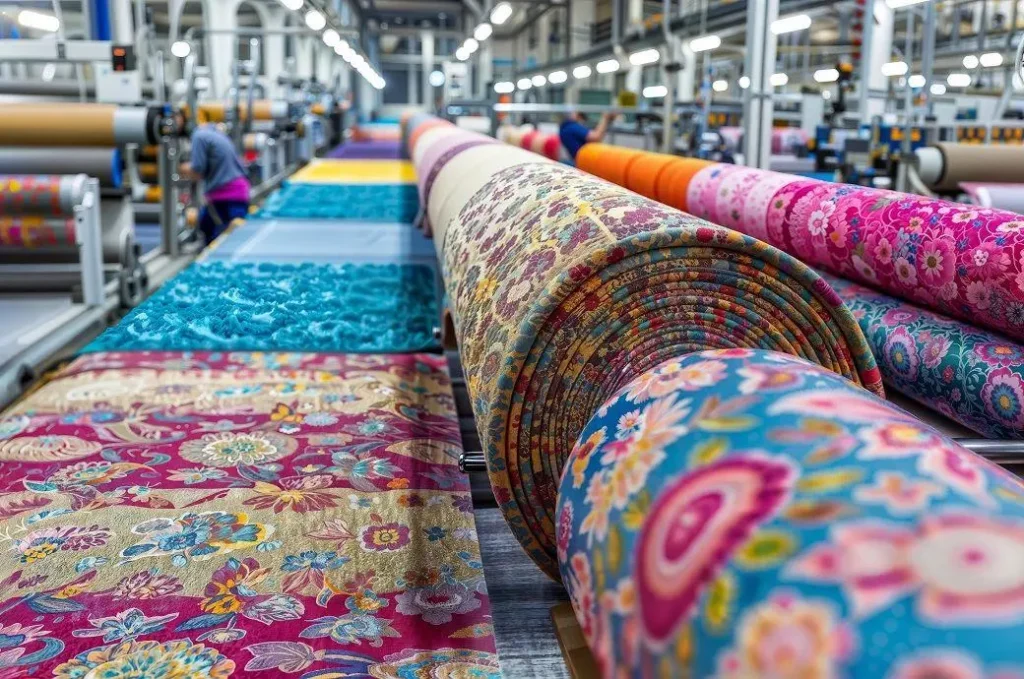
Textile Printing Manufacturer

What a Textile Printing Manufacturer Does in the Custom Fabric Process

Printing is not a single machine pass. A textile printing manufacturer takes your artwork and your base fabric and moves both through a controlled sequence of pre-treatment, printing, fixation, washing, and finishing. Each stage changes how the final cloth behaves. A capable fabric printing manufacturer will also advise on artwork resolution, repeat size, and which ink chemistry suits your substrate, because the same design printed on viscose and on polyester will not look identical. Understanding this sequence helps you ask sharper questions during vendor discussions, and it explains why two quotations for the same design can differ by thirty percent. The gap usually sits in the stages you cannot see on the factory floor tour.

Where Printing Fits Between Greige Fabric and Finished Roll

Greige fabric arrives loom-state, full of size, oil, and natural impurities. It must be scoured, bleached, and pre-treated so ink sits evenly on the surface. Only then does printing happen. After printing, reactive and acid inks need steaming to fix, disperse inks need heat setting, and pigment inks need curing. Washing removes unfixed colour, and finishing adds hand-feel, width correction, and stability. A printed fabric manufacturer that outsources pre-treatment or washing loses control over two of the most failure-prone steps. When quality problems appear later, accountability becomes difficult to trace and rework costs land on you.

Digital, Rotary Screen, and Flatbed Printing Explained

Rotary screen printing suits long runs of simple, limited-colour designs and delivers strong cost efficiency above several thousand metres. The flatbed screen handles heavier deposits and placement prints. Digital printing, by contrast, needs no screens, supports unlimited colours and photographic detail, and makes short runs and sampling economical. A digital textile printing manufacturer can turn a design around in days rather than weeks, which is why fashion and home brands with frequent collection changes now lean heavily on it. Your choice should follow your order size, design complexity, and how often you refresh ranges, not simply which method a vendor happens to own.

Why Your Choice of Printing Partner Decides Final Fabric Quality

A poor print does not stay a print problem. It becomes a cutting problem when panels do not match, a stitching problem when shade bands run through a garment, and a returns problem when colour bleeds in the customer’s wash. Rejections at this stage are rarely recoverable, because printed cloth cannot be resold as plain stock. The cost of a cheaper quotation is usually absorbed later, in reprints and missed shipping windows. This is precisely the risk a reliable textile printing manufacturer removes, by locking process parameters, recording recipes, and repeating them batch after batch. A disciplined textile printing company protects you from this the same way, by treating repeat orders as a discipline rather than luck. Consistency across repeat orders, not the appearance of a single sample, is the real measure of capability. Ask to see two production lots of the same design printed months apart.

Key Factors to Evaluate in a Textile Printing Manufacturer

Once you shortlist vendors, evaluation should move from marketing claims to verifiable process detail. The areas below are where capability genuinely differs, and each one is something you can inspect, test, or ask for documentation on before placing a commercial order.

Printing Technology, Fabric Compatibility, and Ink Systems

Ask which machines run your fabric type and at what production speed. Reactive inks suit cotton, rayon, and viscose with excellent wash fastness. Acid inks are made for silk and wool. Disperse and sublimation inks belong to polyester. Pigment inks print across blends but can stiffen the hand-feel if applied heavily. A textile printing supplier that pushes one ink system for every substrate is optimising for its own convenience, not your result. Confirm that the vendor has actually run your specific base cloth, GSM, and construction before, and request evidence. Our guide to choosing the right fabric for printing explains how substrate choice shapes ink selection.

In-House Pre-Treatment, Steaming, Washing, and Finishing

The most common cause of colour failure is inconsistent pre-treatment, not the print itself. Uneven padding, incorrect pH, or poor absorbency will produce patchy colour no matter how good the printer is. Steaming time and temperature control fixation depth. Washing removes unfixed dye that would otherwise stain adjacent fabric. Finishing then restores softness and dimensional stability. Vendors with these stages under one roof can trace a defect to a specific step within hours. When these functions sit across three job-work units in different parts of the city, every quality conversation becomes a negotiation about whose fault it was, and your timeline slips while that plays out.

Colour Management, Strike-Offs, and Batch Consistency

Insist on a physical strike-off before bulk, approved under a defined light source rather than shop-floor daylight. Ask whether the vendor uses a spectrophotometer and maintains recipe records against Pantone or your own standards. Digital printers should be profiled and recalibrated on a schedule, since print heads drift over time. Also ask how they handle lot-to-lot variation in the base fabric itself, because greige from a different weaver will absorb ink differently. Good vendors record every parameter and can reproduce your shade six months later. Weaker ones will match your sample once and then quietly rely on visual approval for every subsequent run.

Certifications, Fastness Testing, and Quality Control

For export buyers, compliance is not optional. OEKO-TEX Standard 100 confirms the finished fabric is free from harmful substances, GOTS applies where organic claims are involved, and ZDHC governs restricted chemicals in the wet processing chain. Beyond certificates, ask for in-house test reports on wash fastness, rub fastness, and light fastness for your specific ink and substrate combination. Request the inspection process too, including whether fabric is checked on a light table and how defects per hundred metres are recorded. Vendors serving international accounts will produce this documentation without hesitation. Reluctance here is itself an answer, and a reliable one.

MOQ, Turnaround Time, and Scaling Capacity

Minimum order quantity shapes your entire buying plan. Rotary printing typically demands high minimums per colourway because screen engraving must be amortised. Digital printing allows far smaller runs, which suits testing designs before committing capital to inventory. Equally important is whether your textile printing manufacturer can scale with you. A vendor comfortable at five hundred metres may struggle at ten thousand, and one built for volume may deprioritise your small repeat orders during peak season. Ask directly about current capacity utilisation, peak-season lead times, and how they sequence orders when the floor is full. Honest answers about constraints are far more valuable than optimistic promises you will discover to be untrue in month three. Our bulk printing capacity page sets out realistic timelines.

Questions to Ask Before You Place a Trial Order

A structured conversation with a shortlisted textile printing manufacturer reveals more than a factory visit. Keep these on hand:
  • Which ink system will you use for my fabric, and why that one?
  • Are pre-treatment, steaming, washing, and finishing done in-house?
  • What are your current lead times for sampling and for bulk?
  • How do you handle a shade mismatch or a defective lot?
  • Can you share fastness test reports and relevant certifications?
The answers matter, but so does the manner of answering. A partner who explains trade-offs candidly, including where their process has limits, is usually the one whose delivery commitments hold. Vague, uniformly positive responses to technical questions signal a trading intermediary rather than a genuine processing unit.

How to Run a Sample Order and Judge the Results

Never move from strike-off straight to full bulk. Run a small paid trial, ideally a few hundred metres, on the exact fabric you intend to use commercially. Check the print against your approved standard under consistent lighting, then wash a cut piece and compare again. Rub the printed surface dry and wet to test crocking. Examine the reverse side for strike-through and the selvedge for registration drift. Measure width and shrinkage after finishing. This short exercise costs little and exposes almost every weakness a textile printing manufacturer might have. Keep the retained sample, because it becomes your reference standard for every repeat order that follows and settles disputes quickly.
Strike-Off Sample Approval

Working With a Local Manufacturer vs an Overseas Supplier

Overseas sourcing can look cheaper per metre until you add freight, duties, lead time, and the cost of being unable to inspect work in progress. Domestic hubs such as Ahmedabad and Surat give you shorter sampling cycles, easier factory visits, and the ability to resolve a colour issue in a single conversation rather than across time zones. For brands running frequent design changes or seasonal drops, that responsiveness usually outweighs a marginal unit-cost saving. An established local printed fabric manufacturer also understands regional base fabrics and their behaviour intimately. Weigh landed cost and total cycle time together, and consider splitting volumes between a local partner for agility and an overseas one for long, stable runs. Our fabric printing process overview explains how local sampling cycles work.

Conclusion

The right textile printing manufacturer does more than run your artwork through a machine. It advises on ink and substrate pairing, controls every wet stage in-house, documents recipes so your third order matches your first, and tells you honestly when a design or a deadline is not realistic. Evaluate on process transparency, testing evidence, and repeat-order consistency rather than on quoted rate alone, and run a paid trial before committing volume. If you are ready to discuss your fabric, design, and quantity with a manufacturer that handles the full printing and finishing chain in-house, reach out to ThePrintinkco at for a sample and a clear production timeline.

Scroll to Top